Needham Navigator
An open-source RAG engine for municipal content — starting with Needham, MA.
And I thought: What if there were just a clean, AI-native search engine for Needham?
That was it. We (aka Claude and I) started by scraping the town website. Then the school district site. Then the library. Then parks & rec and public documents — 5 content sources total, processed through a 4-tier ingestion pipeline with 38 custom boilerplate-stripping patterns. The search system combines semantic similarity, full-text search, recency weighting, and source-tier ranking to surface answers with confidence scores.
Then Claude suggested scaling the ingestion. Then I blinked. And realized we nearly scraped the entirety of Mass.gov. 49,547 out of 50,000 pages — 99.1%.
Out of thin air, Claude created: structured ingestion pipelines, semantic chunking, vector embeddings, hybrid search, answer synthesis, and fully automated deployment.
Total cost to process and summarize ~70,000 total pages? About eleven dollars. That's less than a Sweetgreen bowl.
System Architecture
At a high level, Needham Navigator is a 5-layer system: user browser → Next.js on Vercel → AI services → data stores → external municipal sources.
The Claude Development Flywheel
The development process became an almost-automated flywheel. Claude CoWork critiques the UX, generates structured prompts, Claude Code implements features, GitHub Actions validates, and Vercel auto-deploys. Rinse. Lather. Repeat.
How Long Would This Take a Human?
I asked GPT, Gemini, and Claude to estimate how long a traditional full-stack engineer + QA would need to architect, build, secure, and deploy this system. Then I normalized everything into person-days and weeks.
| Model | Team | Person-Days | Calendar | FTE Months | Key Constraint |
|---|---|---|---|---|---|
| 🟢GPT | 1 Eng + QA | 320 PD | ~48 weeks | ~11 months | Serial engineering bottleneck; long integration/regression tail |
| 🟢GPT | 2 Eng + QA | 320 PD | ~28-30 weeks | ~6-7 months | Parallelism helps, but coordination + QA gates final stretch |
| 🔵Gemini | 1 Eng + QA | 320 PD | ~43-52 weeks | ~10-12 months | Context-switching across RAG, UI, DevOps; burnout risk |
| 🔵Gemini | 2 Eng + QA | 340 PD | ~26-30 weeks | ~6-7 months | Optimal parallel streams; ~15 PD coordination overhead |
| 🟠Claude | 1 Eng + QA | 139 PD | ~14-16 weeks | ~3.5-4 months | Partial QA overlap; mostly serial |
| 🟠Claude | 2 Eng + QA | 92 PD | ~9-11 weeks | ~2-2.5 months | Strong parallelism; ~15% context overhead |
Not one model said “two weeks.”
The average single-person estimate hovered around a year.
I built it in roughly fourteen days.
Not because I typed faster. Because I orchestrated.
Scraper Flow
A custom web scraper built with Cheerio + Mozilla Readability processes each URL through 6 stages — from raw HTTP fetch to structured storage. 38 CivicPlus boilerplate patterns are stripped during the Clean + Normalize step.
Hybrid Search Flow
Every user query goes through a hybrid search pipeline that combines semantic vector search (pgvector cosine similarity) with PostgreSQL full-text search, then reranks results using a 4-factor formula before generating a confidence-scored answer via GPT streaming.
CI/CD Pipeline
Every push triggers a full CI pipeline: lint, type-check, build verification, and static code analysis via GitHub Actions. Three scheduled workflows handle daily article generation, nightly health checks, and weekly security scans.
Full Tool Stack
More Like This
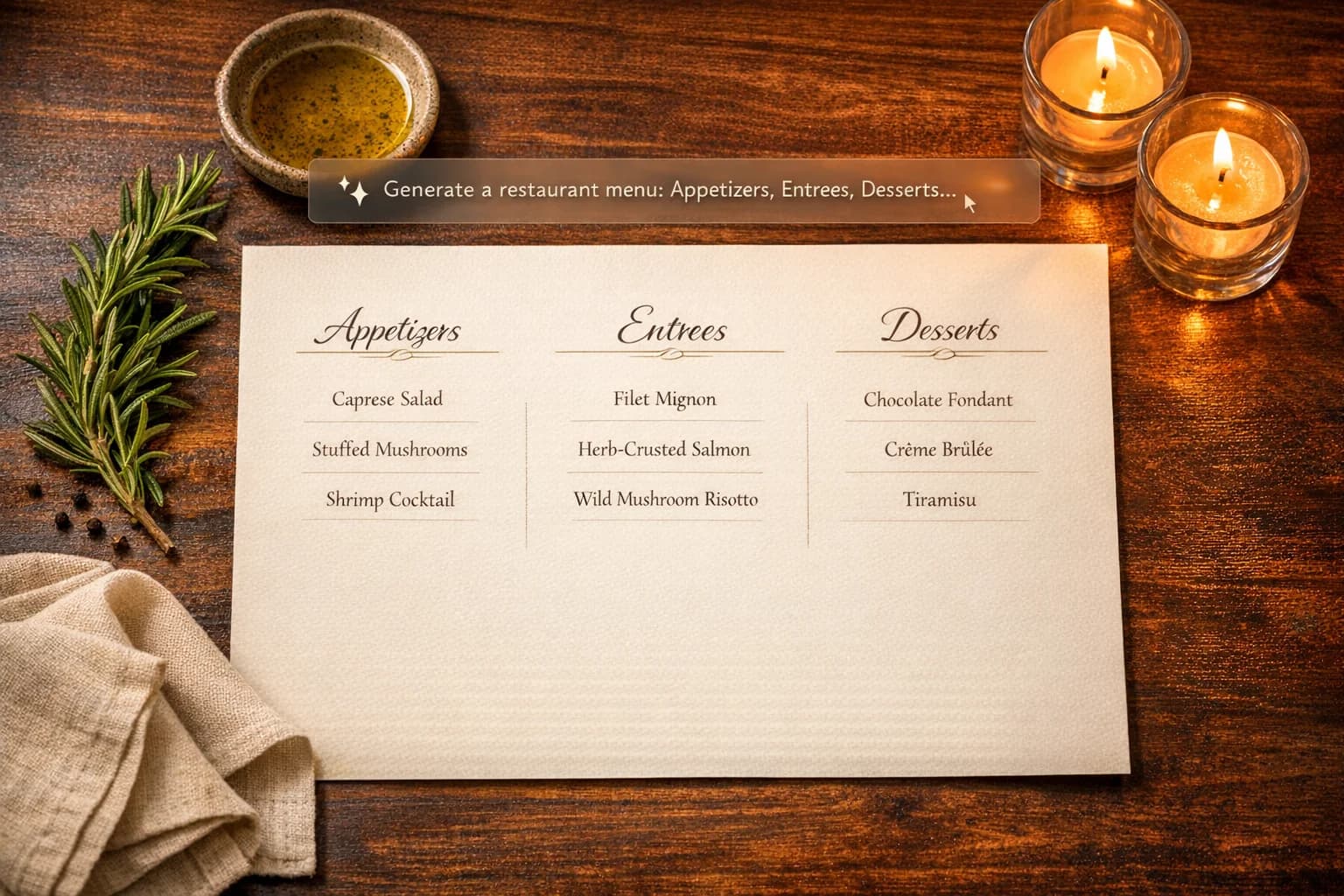
Menu Labs
Prompt-to-menu generator, built for $2.48 on Replit.

SwiftieGPT
Notes from inside the Swiftie Industrial Complex — an AI app that explores the gap between Taylor Swift fandom, parasocial relationships, and what we project onto pop stars. Part satire, part genuine product.

ChartSmithGPT
An AI-powered micro app that converts any table into styled charts with PNG/SVG export. Paste data, pick a palette, download instantly.